
Why practice torso movement?
Why practice torso movement? We can appreciate what we take from it, looking at the body (hardware), what we can do (apps), and how we move (the operating system).
A) Hardware: what is the primary physical adaptation? Mobility in the torso, especially in smaller segments. Don’t forget that all of the big ranges of motion are built up from smaller segments. Addressing a small segment means improving the many larger ranges that include that segment (vice versa doesnt work the same way)z
B) Applications: what movements become possible after such work? First, it allows you to work with improvisation by building up elaborate systems.
It also delivers very important sub-processes : the small separation allows you to recruit more segments in kinetic chains, contributing to better force transmission.
C) Operating system: what effect does it have on how we move? It develops movement quality. For example, the ability to smoothen movements, to dynamically adjust the level of tension necessary to achieve an outcome while maintaining details and standards.

If the handstand was a computer…
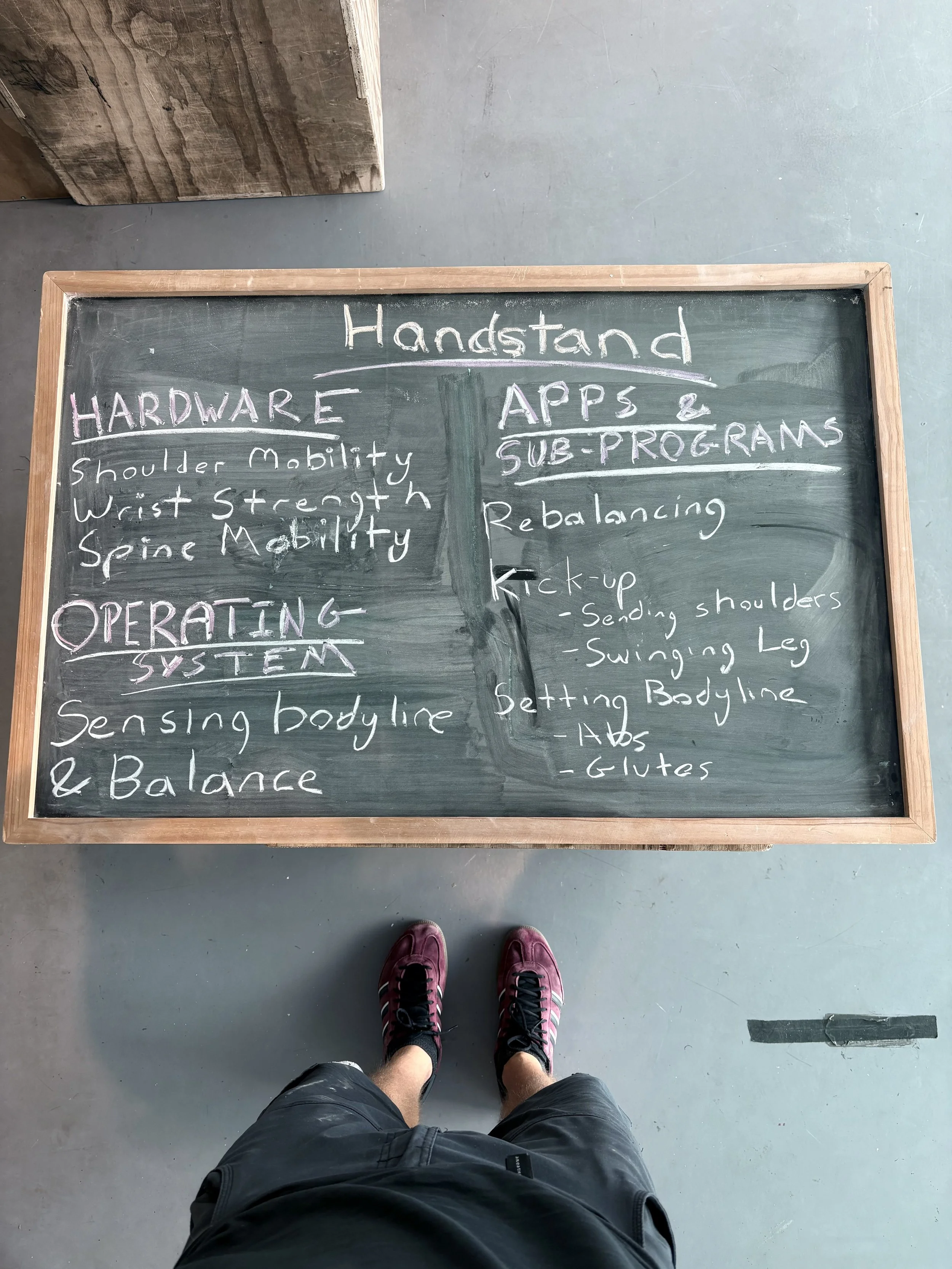
If the handstand was a computer, what would it look like?
This was the model we used to approach the handstand in classes this week.
To perform a handstand requires a certain “operating system”: The internal representation of a body-line (the straight line from the head to the feet), the ability to sense balance (the shifting of the center of mass), etc. The same technical drill can deliver these, or not, depending on where the attention is.
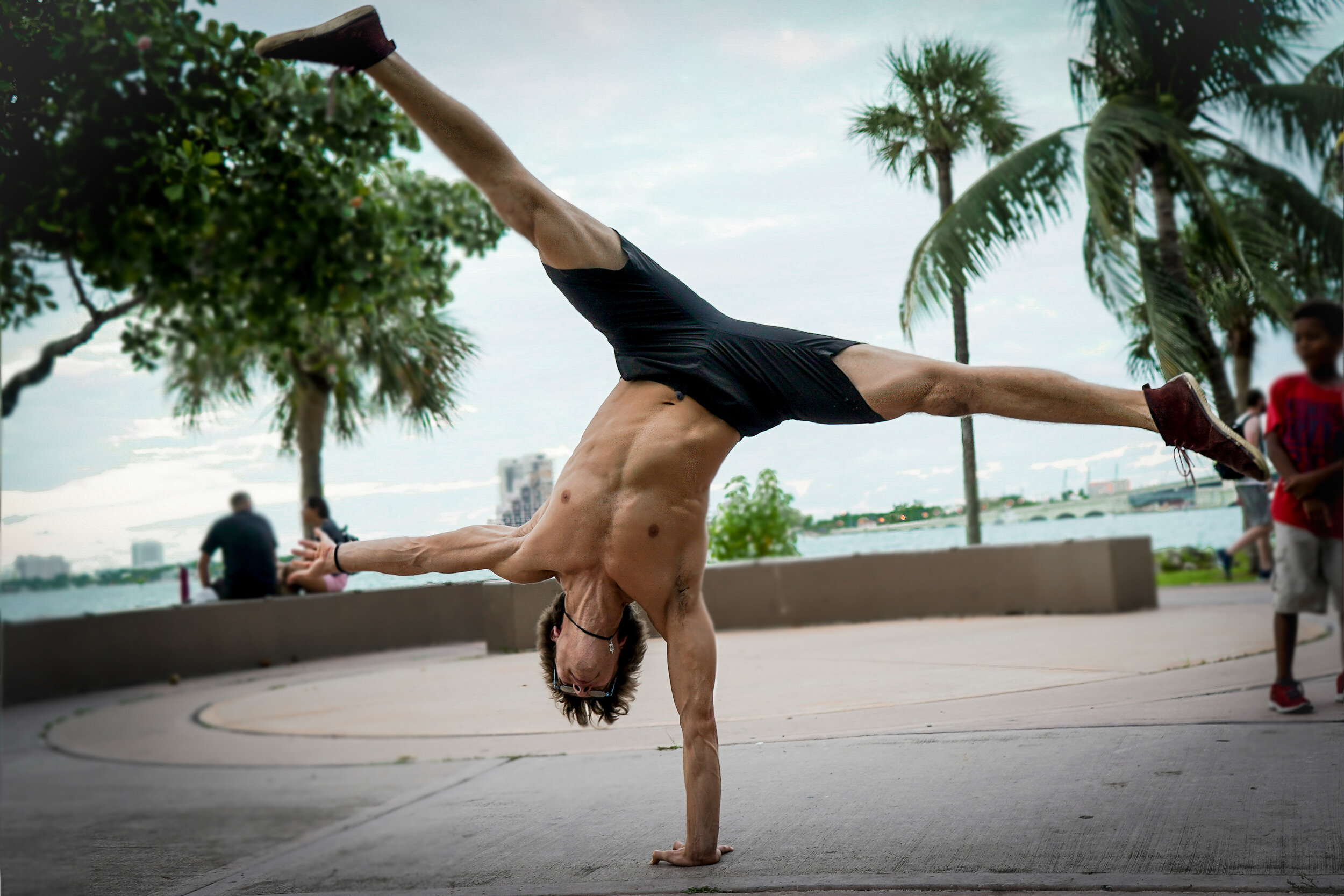
You could look at the one arm handstand and think it’s a huge development over the two arm handstand. In truth the operating system required is very similar. You need only slight improvements in the pre-existing O.S. to achieve it - a small upgrade.
Dynamic freedom on the hands, however, requires a substantial system upgrade. It has dependencies on spatial management, peripersonal space, sensing gradations of tension, etc.
If you’re learning the handstand for YOUR development, you want to focus on the operating system.
All models are wrong, but for now, this one is useful. This model has an expiration date for us. We can use it for some period of time, beyond which it starts to serve itself, and not our own development.

Are Injuries Good?
Are injuries “good”?
Maybe we instead can ask, “how can I make this injury good for me?”
1. A smaller injury can create the awareness and changes needed to avoid a larger injury that was lurking. Awareness to how you move and changing your biomechanics.
2. We can use the rehabilitation process to become even stronger than we were before the injury. Fixing weak links that caused the injury means improving overall performance.
3. We’re so afraid of the unknown, so attached to the familiar face of our practice that when it changes, however superficially (like when we cant do our favorite exercises), we feel a loss of identity. But in reality, a toy was taken away. This taking a toy away is the universe’s infinite kindness, reminding us patiently and with grace, that it will all be taken away, to stop identifying, to look deeper and find something deeper behind the attachments.
An injury isn’t a “pause” to practice - it’s a transitional state. It’s not just the body breaking down, but also habits, patterns, movement itself, different layers of the organism as a whole. The system as a whole loses homeostasis and begins searching for a new state. It’s a time of vulnerability, of instability, but also of great potential for growth as well.

Pain Free Movement
Breaking pain cycles and achieving pain free movement. If a movement is safe, but the nervous system doesn’t think so… it isn’t. So give the nervous system opportunities to re-educate itself.

Movement, Body, and Life are all continuous surfaces
In “A Continuous Shape”, the stone carver Anna Rubincam explains that there are no beginnings nor endings to the parts of the body - it’s all a continuous single surface, manifesting as undulations of slack and tension.
We want to bring the same understanding to movement - to the body itself, but also to how we move, and more broadly, to the recognition that there is no barrier between practice and life, that our being is also one continuous surface of existence.
A practical example: the upper fibers of the transversus abdominus, an expiratory muscle, interdigitate with the diaphragm, an inspiratory muscle. The consequence is that any forceful attempt to regulate breathing limits it - you cannot fully exhale, if you’re also simultaneously contracting the inspiratory muscle.
This digs into the nature of “being” as well. We have our formal practice sessions, but ultimately the endeavor is to bring our practice to our lives, and our lives into our practice, until we realize… it’s one continuous surface.