
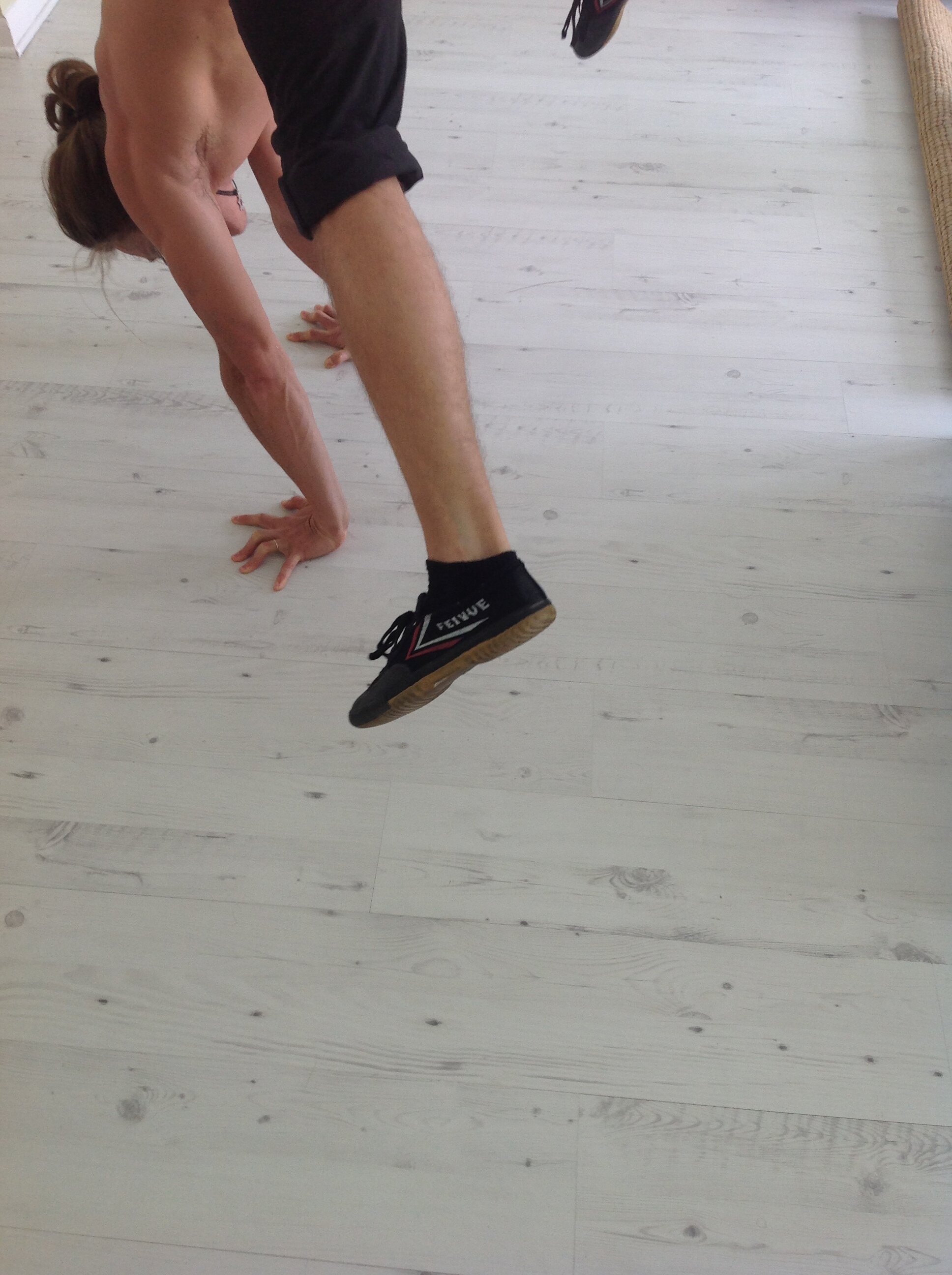
Killing Your Self - Why Eliminating Style Is Beautiful
Style is habit, and a habit is NOT who you are. In constraining style, we evolve. I was conflicted about this at first, but I discovered that eliminating mannerism provided an opportunity to rise above the illusory self I take for granted, and see the outline of something more expansive and inclusive.
Style is habit, and a habit is NOT who you are. In constraining style, we evolve. I was conflicted about this at first, but I discovered that eliminating mannerism provided an opportunity to rise above the illusory self I take for granted, and see the outline of something more expansive and inclusive.
We identify with aspects of ourselves by habit more often than by choice. This is an over-identification, an addiction to a way of being. It is a comfort zone. Even when it is something we dislike about ourselves, we can hide behind the shield of “authenticity”. We are so obsessed with being authentic, that we end up inauthentic. By insisting on being the way we think we are, we are unable to be who we really can be.
I can’t afford to be caught up in how I imagine I am, in pretending to be myself pretending to be myself. So I have decided that my movement practice is a space where style is not permitted, where I aim for the essence and to eliminate all manifestations of style.
This aspect of silencing a false self isn’t about hating my self… it’s because I love that I am, and I want to discover myself. How can I know who I am, if I take for granted that these mannerisms are who I am? I am not what I first saw when I first saw myself. How much of me remains hidden behind the veil, because I refused to look a bit further? Well, this is my process for looking further.
Unexpectedly, this “self”-effacement has only elevated and refined the applications of my “style”. When I let the djinn possess me, when I join in the aether of ecstasis and become the vessel…
But wasn’t that obvious? If manifestations of style are actually forms of possession… if genius comes from genie, and music comes the muse, if all forms of expression comes from the external… Shouldn’t the ability to empty the vessel, to allow for more inhabitation, result in a higher form, a more complex and nuanced and fulfilling form of “expression”?
https://www.youtube.com/watch?v=HV8JyhgeSAw
Tarantism: Movement as healing?

Can you imagine a condition with physiological symptoms such as the blackening of the hands and face, causing vomiting, fainting, and reportedly death, which had no remedy... save for an uncontrolled shaking and flailing that can be said to mimic only dance?
Tarantism is one such condition. What explains such a phenomenon? Is it reducible to anomaly or hysteria? Would it be any more anomalous than the ability of psychological stressors and loneliness to be immunosuppressant or carcinogenic? Does it perhaps instead shed light on the human condition? Maybe that says more of our relationship to hysteria… maybe hysteria isn’t some side-effect of the proper mind, but is rather a proper-effect of the side-mind…
The existence of Tarantism also opens up lines of inquiry within the field of of movement. What is going on with that category of movements that is not just involuntary, but voluntarily involuntary? What is it about movement that we invite, that we can guide but not directly control? Does this overlap with dance? Is Tarantism a dance? Is an exorcism a dance? Or is dance a form of possession - in which you set the parameters with your intentions and background and the patterns stored in your basal ganglia, but you don’t decide what comes next. What’s the name for the factor that decides what comes next? A djinn? A dybbuk?
We’ll be screening a documentary on the topic of Tarantism on November 2nd. Here’s the event page: https://www.facebook.com/events/626958657711019/
“… began first moving the feet, legs shortly afterwards. He stood on his knees. Soon after an interval he arose swaying. Finally, in the space of a quarter of an hour he was leaping, nearly three palms from the ground. Sighed, but with such great impetus, that it terrorised bystanders, and before an hour, the black was gone from his hands and face, and he regained his native colour.”
The Missing Body User Manual
It’s curious - we come into this world with the absolute highest form of technological development, the human body, and seemingly zero instruction on how to operate it.
Why is that? Why don’t we come into this world with a body user manual? At first glance, it would seem obvious that evolutionarily, we should be optimized to survive by coming into this world with only the best instincts. Instincts for eating, for moving, for fighting… Why do I need to train to avoid the startle reflex when I get hit in the face? Why must I work on coordination, timing, distance management (as Ido puts it, installing the booster packs for our instincts)?
One common answer is thatwe are “distracted” from the body user manual by our modern environment. But… maybe the answer is less based on an argument in favor of a lost past, and more… science.
Why, from a neuroscience and evolutionary biology perspective, are we not optimized with a "body user manual” (“perfect” instincts)?
The reason is… because not having a body user manual IS the most optimal. By sacrificing a user manual, we ended up with something much greater - the most neuro-flexibility of any animal.
Unlike other animals, we don’t have a “natural” way of being. Our natural way is to invent artifice at the first opportunity. This allows us to be the most complex creatures on this planet, the most anti-fragile, the most creative… We can pick and build our instincts, to create the vision of ourselves that we wish; that’s amazing enough that I could spend all day doing it…