
Of Tools & Biases
we are the creature that can selectively wear idealogical biases like costumes for the masquerade, pragmatically or aesthetically or exploratatively dancing between “constructions” and “values” and “senses or skills or attitudes”.
Choose and use your tools, and choose and use them wisely.
Embedded in every tool is an ideological bias, a predisposition to construct the world as one thing rather than another, to value one thing over another, to amplify one sense or skill or attitude more loudly than another.
Neil Postman
So what’s the solution - to shed all tools, and go back to a pre-tool era? As if we could dig deep enough to end up there - and when we did, we would end up realizing we only got there by virtue of a digging tool, accidentally sneaking in this sacrilegious trojan horse of an instrument and its heretical taint of artifice into the garden of eden, desecrating Postman’s paradise.
I’d rather embrace tools for their power to change us - we are the creature that can selectively wear idealogical biases like costumes for the masquerade, pragmatically or aesthetically or exploratatively dancing between “constructions” and “values” and “senses or skills or attitudes”. Choose and use your tools, and choose and use them wisely.
What does that look like? “Repurposing” tools doesn’t hit the nail on the head - retooling our purposes, perhaps, inches nearer the mark.

Can You Practice Into Old Age?
The good news here is that you can practice till your last moment, and you can do it beautifully, without sacrificing the things that make movement practice singularly special - quality and attention to detail, the work ethic it demands, the fears it puts you up against, the way it connects the seemingly disparate, the exploration and adventure and growth that characterize it.
Can you practice into “old age”?
It’s a question no one has the luxury of running from… and yet it’s not such a popular topic. And when it is confronted, it is done so with the belief that if you are going to continue practicing with age, it ill have to be a watered down version, performed with less intensity.
But an attitude of resignation is unwarranted. There is room, not just for optimism, but for an uncompromising excitement for the future. A movement practice not only persists into old age, it transforms and evolves with you. And it can be done full on, with maximum intensity, without sacrificing work ethic.
People equate a serious work ethic, going “full on”, with damaging the body. There are many ways to practice full on; it’s highly simplistic to treat physical load and standard stress to standard tissues as the marker of the intensity of a practice.
Go full on... in layers such as focus, attention to detail, patience. Even asking the difficult questions “is this the right thing for me to be working on?“
And that’s the other issue here… what is the orientation of your practice? Not the “what”, but “where” you are going with it? Is it deliberately chosen, or did it choose you, by falling into your lap at the right moment?
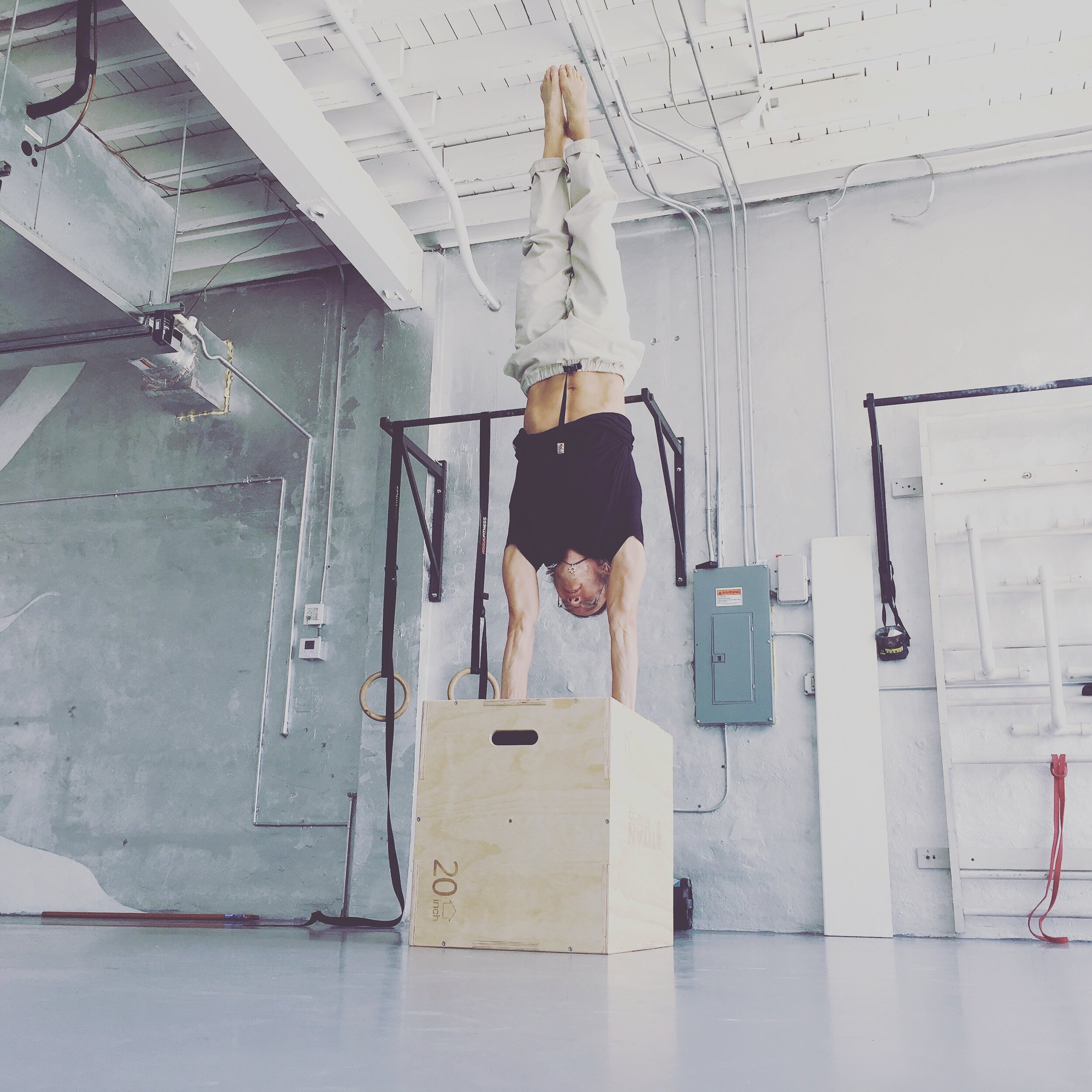
If you don’t re-orient yourself, if you don’t change the what (or even the how), it you don’t let things evolve, you’re in trouble. No amount of periodization and volume management schemes, no matter how complex, will change that. If all you do is handstands and strength work, where the diversity of “what” is so minimal, you’re going to pay the price.
We are all dealing with it at some level, and we can’t afford to turn away from that question - whether we know it or not, we are making the choices now that define the future. The good news here is that you can practice till your last moment, and you can do it beautifully, without sacrificing the things that make movement practice singularly special - quality and attention to detail, the work ethic it demands, the fears it puts you up against, the way it connects the seemingly disparate, the exploration and adventure and growth that characterize it.
It’s not about delaying the age at which you stop practicing; nor is it about holding onto the past; it’s about embracing the wheel of time - we want complexity, growth. How could we grow, our prime mandate, if we hold so strongly onto the past? If you can’t figure it out on your own, age will try to force you into seeing the bigger picture; yet sometimes we manage to keep our eyes shut and continue marching forward along a path that takes us to a place we have no desire to be.
You can go infinitely hard, you can maintain a beautiful ever-evolving, ever-complexifying practice into old age, until the day you die, if you can respect that.
How to Create Complexity
A complex system that works is invariably found to have evolved from a simple system that worked. The inverse proposition also appears to be true. A complex system designed from scratch never works, and cannot be made to work.
John Gall, Systemantics
What kind of systems are we working with that this would be relevant for us? Two spring immediately to mind - both our movement practice (as a discrete entity) and the mindbody phenomenon are characterized by systems behaviors, and it helps us to consider them both with those tools.
Complexity is a function of connections. Not engineered, but evolved connections. How can these be nurtured? I like to say:
Some people change the task when they get bored; we use boredom as a sign to stick around a bit longer. Some people stick with the task when they get good; we use proficiency as a sign to move on.
By doing so, we create the only thing that we, as beings with intentions, can - an environment which gives connections enough time to arise (where the human inclination is to give up at the pinnacle of challenge, which often sits right before the point of opportunity of growth), and simultaneously maximizes the one resource we have to use: time, by minimizing the time allocated to things which have nothing more to offer us in the sense of growing in complexity (again, against the human inclination).

Practice in the time of Coronavirus
During the lockdown, we maintain our practice with full intensity.
The best definition which has ever been given of a high standard of organization, is the degree to which the parts have been specialized or differentiated
- Charles Darwin.
The world grinds to a halt to curtail the spread of a novel virus. But we won’t let the disruption or isolation hold back our practice.
“You are only as strong as your weakest link”. But what does that look like when the rubber hits the road, in the day to day of living our lives? If you are only as good as your worst day, it stands to reason that when the shitty day comes (and it ALWAYS comes), you can’t bury your head in the sand.
So during the lockdown, we maintain our practice with full intensity. We are aware, of course, that we have been separated in some sense from our tribe, and that our practice is missing a critical layer. But we can’t afford to stay stubborn; we must be adaptive, responsive.
Don’t wait for motivation and easy days, for the time when your friends will be around to practice with; prepare for them. Because they always come back - and when they do, if you weren’t busy growing during their absence, you start again from scratch.
And if we value the idea of being the generalist, this is a time to examine what that means, practically.
The best definition which has ever been given of a high standard of organization, is the degree to which the parts have been specialized or differentiated
- Charles Darwin.
The arms manipulate, the legs locomote, etc… BUT Darwin never said the WHOLE is specialized, only the parts. WE are not specialists - we don’t practice only when there’s a certain context, in a specific place, at a certain time, we don’t over-identify with any layer of our practice.
This is nothing less than an opportunity to work on mindset, to build robust bonds with your tribe through other means, and to keep looking at the big picture of practice from as many angles as possible.
Practicing to Understand (Mindbody)
A movement practice is an excellent way to model the mindbody phenomenon; by giving us reference after reference of what it IS, from as many vantage points as possible...
Hypocognition is usually used to refer to things besides ourselves... but what about turning that lens back upon ourselves? What don’t we see, of who and what we are, for lack of models and mental machinery which manufacture the context for making our own existence comprehensible?
Hypocognition is a term from the intersection of linguistics and cognition, identifying an inability to understand something, because you cannot model it. In cognitive linguistics, modeling is assumed to be achieved by assigning words to things, but more broadly, when we lack representations (whether they are words, or images, or mathematical formulations) for a given concept, we cannot really grasp it - we cannot even understand that we don’t understand it.
“You can see an object or idea and still not realize its significance or its meaning unless you have developed the mental machinery to put it into the functional context that it needs to be in to provide you with clarity”.
Zat Rana
(Not so) coincidentally, a movement practice is an excellent way to model the mindbody phenomenon; by giving us reference after reference of what it IS, from as many vantage points as possible...
Mindbody is something which we are/inhabit/manifest. It speaks to a whole made of pieces that cannot be separated without losing the meaning of the whole - but at this point in our social evolution, we still fail to describe that second order relationship well. Maybe it is for a lack of practices that truly aim to crack that dichotomy. Maybe such practice can begin to yield references, for example, for what it means to “inhabit a body” and “be that body”, simultaneously.
Hypocognition is usually used to refer to things besides ourselves... but what about turning that lens back upon ourselves? What don’t we see, of who and what we are, for lack of models and mental machinery which manufacture the context for making our own existence comprehensible?