

Fallacy of teleology of design
The origin of the design doesn’t speak to whether it is right to use it for a purpose. That’s an illusion - the fallacy of teleology of design (a trap I walk into on a regular basis). Fate happens now, and we decide what things are “made” for, by using them for such.
What it was made for is a starting point, not an ending point. It may determine parameters which constrain future repurposing, vectors which determine what directions of growth are possible. Of course, mind the origins of the thing: It speaks to respect, ancestry, humility. Bind the sacredness of origin with the pursuit of complexity.

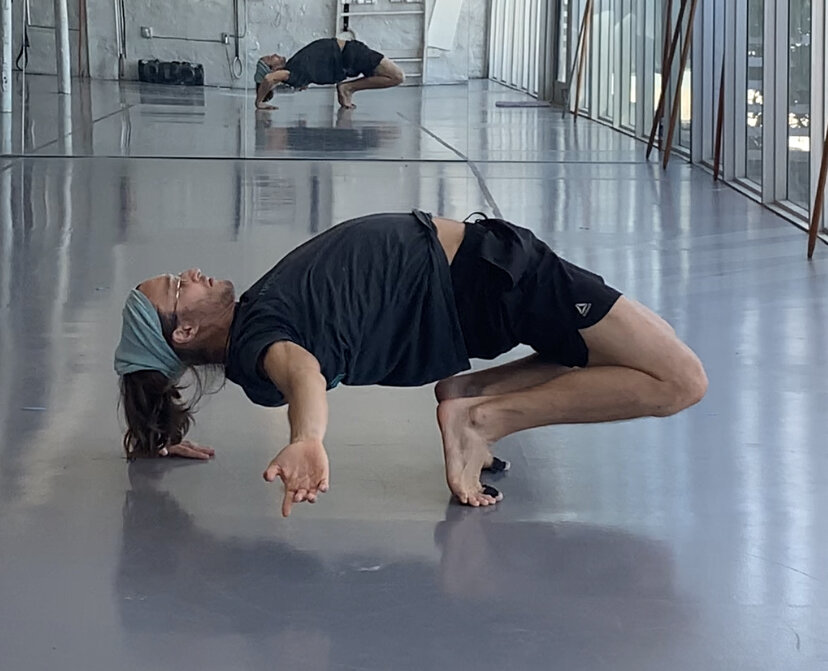
“That’s not made for that” - Passerby pointing at the rail, commenting on me working on rail balance.
And the internet wasn’t designed by the Department of Defense for cryptographic records, and yet we have blockchain, nor for upturning financial systems, and yet we have cryptocurrencies, nor was it made to amplify our social nature, and yet we have social media. And onwards we march, towards web 3.0.
Nor was the body made for modern food nor our feet for shoes. Fingers weren’t made for spelling, much less for reading (braille). Whatever you’re doing with your body, after the age of 6 months, you can be sure it wasn’t “designed” for that.
The spine wasn’t made for expression. In fact, there is a whole class of structures/functions which the absence of doing non-designed things with causes a deterioration of. You sometimes have to use things in ways they weren’t intended, to maintain their capacity for general functionality.
One more: the breath was not made for focusing, the mind not made to be analyzed. And yet, what vista into the nature of consciousness they have opened for us. Maybe that speaks to the penultimate question, of what is the mindbody phenomenon for? Maybe it doesn’t matter.
None of this speaks to the “right” thing to do with a technology; the origin of the design doesn’t speak to whether it is right to use it for a purpose. That’s an illusion - the fallacy of teleology of design (a trap I walk into on a regular basis). Fate happens now, and we decide what things are “made” for, by using them for such.
What it was made for is a starting point, not an ending point. It may determine parameters which constrain future repurposing, vectors which determine what directions of growth are possible. Of course, mind the origins of the thing: It speaks to respect, ancestry, humility. Bind the sacredness of origin with the pursuit of complexity.
We should be careful about falling into this fallacy of the teleology of design - it applies just as much to the technologies around us as much as the technology which IS US.
Moving forward
We’ve reopened for about a month now, and I have had time to process a lot of thoughts from the prior lockdown, and see certain ideas take shape.
We’ve reopened for about a month now, and I have had time to process a lot of thoughts from the prior lockdown, and see certain ideas take shape.
The change of pace during the lockdown gave us much-needed room to step back and look at things from new angles, ask new questions, and especially consider how we can do a better job of what we are trying to do, including sharing with a small community and perpetually elevating our own practice.
It was tumultuous and filled with doubt and uncertainty. I had not been pleased with how our classes had been evolving prior to the lockdown. And I felt too slow to react, always a step behind. So when the global pause button was hit, I jumped at the opportunity to recalibrate, reorient, realign.
I decided that if I was to continue teaching classes, a few changes would have to happen. Limiting class sizes, not for hygiene, but to match my still-growing ability as a teacher to manage a group. Changing the way decisions were made about what to share, and also… HOW to share them. And of course, making an explicit priority for myself of developing as a teacher and leader of a community.
And a month after reopening our doors to students, I can say… it was the best thing that could have happened for us. I’m amazed and humbled and grateful for the wonderful group of practitioners we have here. We are less focused on growing at the moment, and more focused on going deep, setting strong roots based on practice. I have a much clearer sense of what we’re about, what direction we’re trying to take students in.
All those words just to say... thank you all, just for sharing together this ride called life, whether from close or afar.

Meditation & Self
Meditating isn’t about being alone with your thoughts; it’s about being alone without them.
We finished a session last week with a 30 minute standing meditation (for those who wanted to stay a bit longer - which turned out to be 99% of the students). As we wrapped up with a discussin, the phrase “ego death” came up to describe the experience.
I am reminded of a misconception, the idea that meditation/stillness is about being alone with your thoughts. Maybe not, however: meditating isn’t about being alone with your thoughts; it’s about being alone without them. And discovering, there is still some “thing” there. As the students put it, ego death, the cessation of the default mode network.
Lately, we have been working on a kind of “proprioceptive hack” in our meditation, using the weird relationship between body and mind to create a loop that gradually reduces the noise of thoughts. It’s a brilliant device learned from our teacher, Ido.
In this practice, something curious arises - we lose the default sense of our body (reminiscent possibly of psychedelics?), and this has a distinct effect on the sense of who/what we are. Which speaks to the rub in the riddle of the mindbody phenomenon - your sense of a body is constructed. And that sense influences how you experience your self - in fact, it isn’t separable from it: as you change how you sense your body, YOU change. Losing your body means losing the distinction between you and the world around you - that’s not an illusion… it’s just another state of experience, no more and no less descriptive than any other, but certainly less common. Rodolfo Llinas, the researcher, gives us the beautiful metaphor “I of the Vortex”.
Looking forward to another week of playing in the vortex.

Coronavirus Lockdown Lessons
Nine joyful lessons from a global lockdown, as we emerge from our respective caves.
Nine joyful lessons from a global lockdown, as we emerge from our respective caves.
1 - You don’t need to see a persons whole face to catch a smile. Eyes are beautiful and mysterious indeed.
2 - I spent most of my time practicing at a nearby marina. I met countless people, young and old and of all different sorts, all engaged in different pursuits. We kept our distance, but that didn’t make us distant to each other. Our paths never would have crossed, but for this event.
3 - It only takes a few times in a row saying hi to the most recalcitrant person, before they start saying hi back, and eventually a silent companionship is born.
4 - There’s nothing wrong with small talk (but I still have a long way to go). 5 - When shit hits the fan, the things you do regularly become anchors in your life. And yet, we are so much more than our routines.
6 - You can only organize your socks so many ways. (And in a gesture of absolute nerdness, I installed both Devonthink and Omnifocus.
7 - People are quick to judge. And yet… most everybody simply wants the best for society; people just differ on the trajectory/map.
8 - Vikings is the best tv show. Sorry, Game of Thrones.
9 - Dungeons and Dragons is not a “game”. It is improv, standup, acting, and a sandbox for personal/psychological studies. Oh wait, that makes it a game, but in the sense that James Carse talks about when he talks about infinite games.

Meditation and Memories
I have very few memories of my childhood. There is a near complete blackout spanning one year (I think it’s not a coincidence that it’s the year we huffed freon gases from some apartment air conditioning unit till it was empty), a few specific recollections from the years 13-18, and maybe 5-10 distinct memories prior to the age of 10. Proper chronological recording doesn’t exist in my head until around 20 years of age. (And the reason I write furious notes? Because I know all too well how fragile memory is)
Since our last mentorship meeting with Ido, I established a very consistent stillness practice - no days missed. It’s not easy - I have the mental equivalent of a marching band on amphetamines. But I made the decision not to miss a single day (Even after coming home at 6am after a night of intense dancing, I sat down to do my practice).
Over the months of this unyielding commitment, there is a slowly maturing ability to stay focused while seated, and with this, interesting consequences arise, and I wanted to share this one: during one seated meditation session, suddenly a memory of childhood arose, extraordinarily detailed. I saw it and FELT it like I was present.
The purpose of the practice wasn’t to find a memory, so I didn’t stay with it. It was enough for me to know they are tucked away, that I can grab them. And so it has been with endless other experiences - from feeling new forms of happiness and gratitude, to more and more what silence sounds like.
I have many things for which to thank my teacher, but no contest, this one takes the cake.