
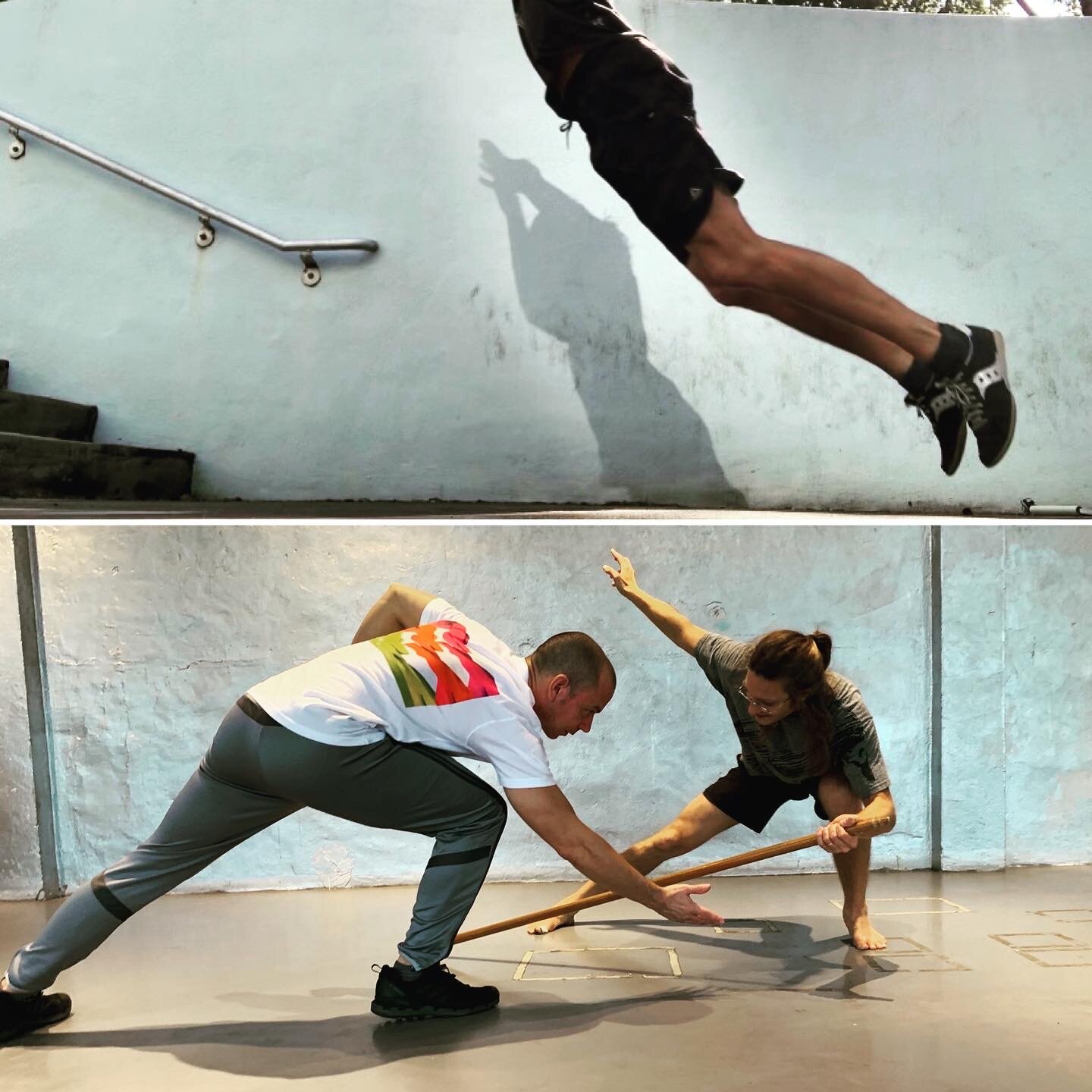
Statistics and Movement Practice
If I simply drop sugar into my coffee, the coffee doesn't sweeten. If I simply stir my coffee, again, the coffee doesn’t sweeten. But if I do both, something happens - my coffee gets sweeter.
We can say in statistical terms that there is an interaction between the two variables: how much I stirred, and how much sugar I put in my coffee, on an outcome - the sweetness of my coffee (for the record, I hate sweet coffee). Effects of single variables interact with each other to yield secondary effects.
This is known as an interaction effect in statistics - when the outcome isn’t dictated only by the sum of the parts of contributing factors, but also by an interaction effect. (The "interaction term" is the quantification of this effect).
Ido recently shared the “Stick Game”, an exemplar of a low-tech, high-result, endless development type of game. But it is also a succinct and clean demonstration of the interaction effect in action: you would think that simply improving reaction time, or footwork, etc, would directly improve performance in a tactical game. But it isn’t enough. There is a need to go beyond working on attributes, and to pull them together in an organized fashion.
And that is what such a game does. Ido has presented countless games, tasks, scenarios, time and again, which serve as platforms for addressing attributes at a higher level. To develop, not just a raw attribute, but at a higher level of complexity, the organization of those attributes (which becomes closer to the amalgam that is you yourself).
The platform, in a sense, also serves to recalibrate your new upgraded hardware and software, by giving it wet-tests, immediate feedback, and over time these new attributes become more finely tuned into the totality of the system, rather than being some external unappropriated capacity.
This is a higher order way of thinking, and makes sense of things where more simple approaches fail to render understanding of a situation. The interaction effect and two of it’s children, the mediator and moderator effects, are very useful heuristics for analyzing the world around us.

Creativity & Learning
Since when is creativity about doing something different than somebody else? Since when does a thing have to look different to be different?
The learning process is ALWAYS new - you are figuring something out nobody has done before: how to solve a problem with your particular mindbody configuration/constellation. It doesn't matter that the person next to you seems to be doing exactly the same thing; this is the world of the black box, and inside, the experience is completely different, and the tools you use and how you use them to figure things out are worlds apart from your neighbor doing the same task.
Also... creativity for it's own sake also is problematic - a concept I have learned from Ido and that has changed so much of how I work. We should be aiming to solve problems, and use creativity as one means to solve those problems.
You don't need to add a flourish to be different. You are what you are, with all your similarities and differences. I came into this more general practice from a practice focused more on layers of expression and catharsis. I immediately had an urge to differentiate myself, to look different or unique when doing the work. That has fallen by the wayside a long time ago. I don't care to look different from my neighbor... My head is bent down, and I'm solving the riddle that emerges when I meet the task before me.
And I leave all this with a question - does something need to feel creative to BE creative?

On time, and an Interview with Movement Practice Paris
When I was playing capoeira many years ago while working at a coffee shop, during my 15 minute breaks and longer lunch breaks I would go to the back parking lot to practice. Between school classes, same thing. Didn't matter where I was, or how odd I seemed juxtaposed against the backdrop of dumpsters, asphalt, etc.
In my masters, I would wake up long before internship began, put my mattress up for some space, and train in my room. During lunch breaks at internship, I would practice the work Ido had begun sharing in the blog. After classes, I would go to capoeira class. To maximize time, I ate in the bus/train my long-since-cold tofurkey and pasta from a tiny tuperware (yes, EVERY fucking night).
The pattern repeated itself in my phd, and elsewhere besides.
It has been a long time since every aspect of my life became unified around one thing - practice (and also since I ate tofurkey). So I briefly forgot these moments. It was only in this recent interview (in French) with Alain (of Movement Practice Paris), when we discussed how people deal with lack of time, that I recalled these to give them as examples of managing time.
Alain asked me what a person with 10 minutes in the day should focus on, what would be most important to practice. My answer was this - stillness practice. Because from there, the agitations and disturbances that otherwise disorient you the rest of your day settle a bit, and you begin to see where your own actions actually created blockages and leakages (including subtle choices and habits that prevent you from pursuing the things that matter to you). This is something that has become most evident to me after studying the work of the psychoanalyst Kourosh Dini who has talked about engaging work in ways that have been very influential for me.
And now, I ride the bus, and it’s a moment to work on my eyes. The time between engagements of the day is not sacrificed to the god of scrolling, but to practices of emotional intelligence and other personal projects - whether reading old entries or examining posture or playing with somatics... (and sometimes semantics). Hell, even writing a post... it's all practice.
So is it possible to make practice central in your life, when you have other things going on? Yes, of course it is. It’s about prioritization. Maybe it was easier in the era prior to social media, but I think not - my peers were busy talking or smoking cigarettes or eating to pass the time, long before Facebook (or even myspace), but I had no such interest.
Cognition, Vision, & Corrective Eyewear
The optic nerve has a direct synapse on the reticular activating system, which in turn regulates arousal and consciousness. Dr. Huberman explains that this connection results in a unique relationship between visual habits and states of mind: visual focus on a single object produces a distinct psychophysiological state as opposed to letting the eyes rest on landscape. Allowing the eyes to saccade over a landscape allows the nervous system to tone down arousal.
Plot twist: eyeglasses affect your visual habits. Jake Steiner, who has the blueprint for reversing myopia, has observed that people who wear glasses change the position of the head, rather than move the eyes around, to visually take in an environment.
I hypothesize the following interaction - wearing glasses causes a longterm shift towards perpetual low-grade arousal, and deprives us of the psychophysiological release that vision would otherwise cue. A simple piece of curved glass causing profound and persistent changes in our mental and cognitive habits.
All my life, I assumed so much of my personality was due to some genetic innate thing.... and yes, my DNA reveals some pretty weird mental and psychological predispositions (like anybody else, I have to assume), but this realization separates something I thought was PART of me, a certain cognitive-mental-psychophysiological profile and default state, giving me distance from it.
And of course, it won't remain theoretical - my journey to reduce my eyesight yields consistent fruit: by changing habits and reducing the corrective power of my glasses, I'm down 2 diopters and still improving...

On planning, reacting, and teaching classes
A personal challenge I am overcoming: over-valuing deep thinking & planning of classes & projects and under-appreciating simple clarity. I have tied myself up into vicious gordian knots countless times by looking for the perfect Pythagorean harmony of concepts... at the expense of asking simply - what comes next?
“The scientists of today think deeply instead of clearly. One must be sane to think clearly, but one can think deeply and be quite insane.” - Nikola Tesla
A personal challenge I am overcoming: over-valuing deep thinking & planning of classes & projects and under-appreciating simple clarity. I have tied myself up into vicious gordian knots countless times by looking for the perfect Pythagorean harmony of concepts... at the expense of asking simply - what comes next?
The addiction to the search for first principles trips me up. I begin to plan a class, for example, and quickly imagine all the things I need to transmit, across all time scales and domains, all the connections I could draw, and hours later the product is a convoluted tangled mess which fails to deliver the potency expected.
But I realized, I don't need some amazing plan - I need simply to observe. From there, I can think clearly, much more so than by over-focusing into a psycho-ciliary spasm.
(And so it is, in almost every facet of living...)
There are no extraordinary plans; I'm reminded of something Ido mentioned in a past interview - that things aren't being executed according to some elaborate plan, but rather that there is a process of reaction going on. And the wisdom of that makes sense to me now at another level than it did then (it's been sitting inside my mind for years, as I've been trying to digest that single idea...). It requires maybe a comfort with the chaos, a willingness to handle the unpredictable by keeping your eyes peeled and staying on your toes, refusing to sink into the complacency of a pre-made plan. But the result is that classes now feel more like a process of research, a shared journey, rather than executing some perfect plan... and I am more alive for it.