
Zettelkasten Torso Differentiation
Zettelkasten is a note-taking method which involves connecting relatively small notes into a web. This method adheres to principles which are very similar to the approach to torso movement that Ido has taken us through.
Zettelkasten is a collection of notes of the smallest possible size (that still communicate a useful unit of information) and their links to other notes to produce webs of ideas. This produces notes which are simultaneously self-contained but capable of belonging to more complex topics and ideas. This is far more versatile compared to siloed information in which an idea can be reached at through very limited pathways.
Torso Segmentation
Ido has taken us through a process of gradually refining the torso into smaller and smaller discrete segments. Each segment can simultaneously articulate on its own as well as optimally contribute to entire kinetic chains for force transmission. In essence, the structure of the torso is dissolved and then the whole is rebuilt as a web of connections.
Benefits of Segmentation
For both movement and note-taking, there are benefits to this approach of reducing the system to the smallest discrete units of information or articulation and then creating a new upgraded system through webs of connections…
1. A smaller but connected note can participate in multiple lines of reasoning. A segment of torso can contribute to multiple trajectories of force transmission.
2. Both the smaller note and the segment of torso can be tailored individually to fine tune the larger systems to which they belong. Discrete units can be organized, concatenated or spliced to better serve a bigger picture.
The Zettelkasten Torso
Marcel Mauss observed that the way we walk depends on the cultures we are raised in (3). The way we move our spines depends on the way we walk (and the demands gait imposes on the skeleton). This results in a specific infrastructure, but that infrastructure can be deconstructed and reconstructed to produce a more versatile torso… the zettelkasten torso.
Fun fact: one of the major advocates and tinkerers in the zettelkasten space has frequently quoted Ido (1)
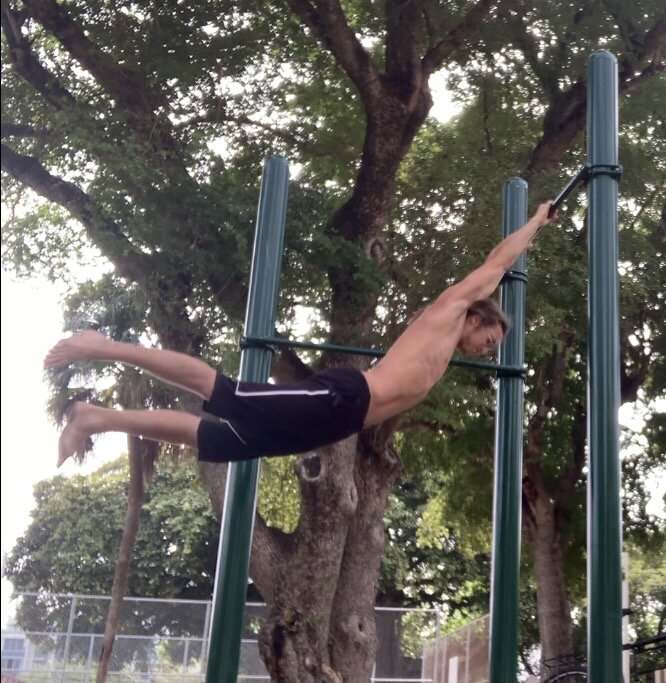
In Search of Fundamentals Of Movement
What would “fundamentals” of movement be? First things first, how do we even decide if something is fundamental?
Chronological Fallacy
There is often a “chronological fallacy” deciding that what is fundamental is what came prior. For example, the motor control challenges of infancy are fundamental for development at a particular stage in life. Some people, taking those challenges for absolute fundamentals, continue to work on those in adulthood, believing that those are fundamental to movement, broadly.
An analogy to clarify the fallacy: imagine you want to grasp the fundamentals of “navigating boats”. There is a period of time in which what is fundamental is knowledge and skills surrounding building of boat, prior to the existence of the boat. But once the boat is built, the scaffold removed… that skillset is no longer so fundamental. Now, navigation becomes the real fundamental thing. The area of “building of boats” is fundamental only through that one single connection, that moment that it leads us to navigation.
Once we have passed a certain stage, what was fundamental for development is no longer fundamental.
That doesn’t really tell us how to decide what is fundamental, but it does tells us how NOT to decide – by arguing to what arises first.
Do the same thing, but differently
To identify what IS fundamental, it is maybe helpful to look at another situation: a bipedal human coming across a vertical rock wall.
If you practiced bipedal locomotion with your mind only ever thinking in a specific manner (looking to improve bipedalism, at the cost of anything else, without looking to find broader more universal principles because you have decided you are a bipedal locomotion specialist), you would be lost when confronting the vertical rock face.
But if you practiced that exact same bipedal locomotion, only with an eye for general principles, when it came time to work with the rock you would find yourself somewhat better prepared.
So it was in practicing bipedal locomotion in a generalist manner that you came upon something that was relatively more fundamental, than if you practiced in a specialists manner. That thing might have been contralateral weight shifts, or the discovery of the general principle of balance (center of mass over base of support), or in how to optimize tendons for absorbing and releasing energy in locomotion…
Therein lies a hint of the criterion for fundamental-ness.
On musical modes, harmonic intervals, and transitional elements in movement
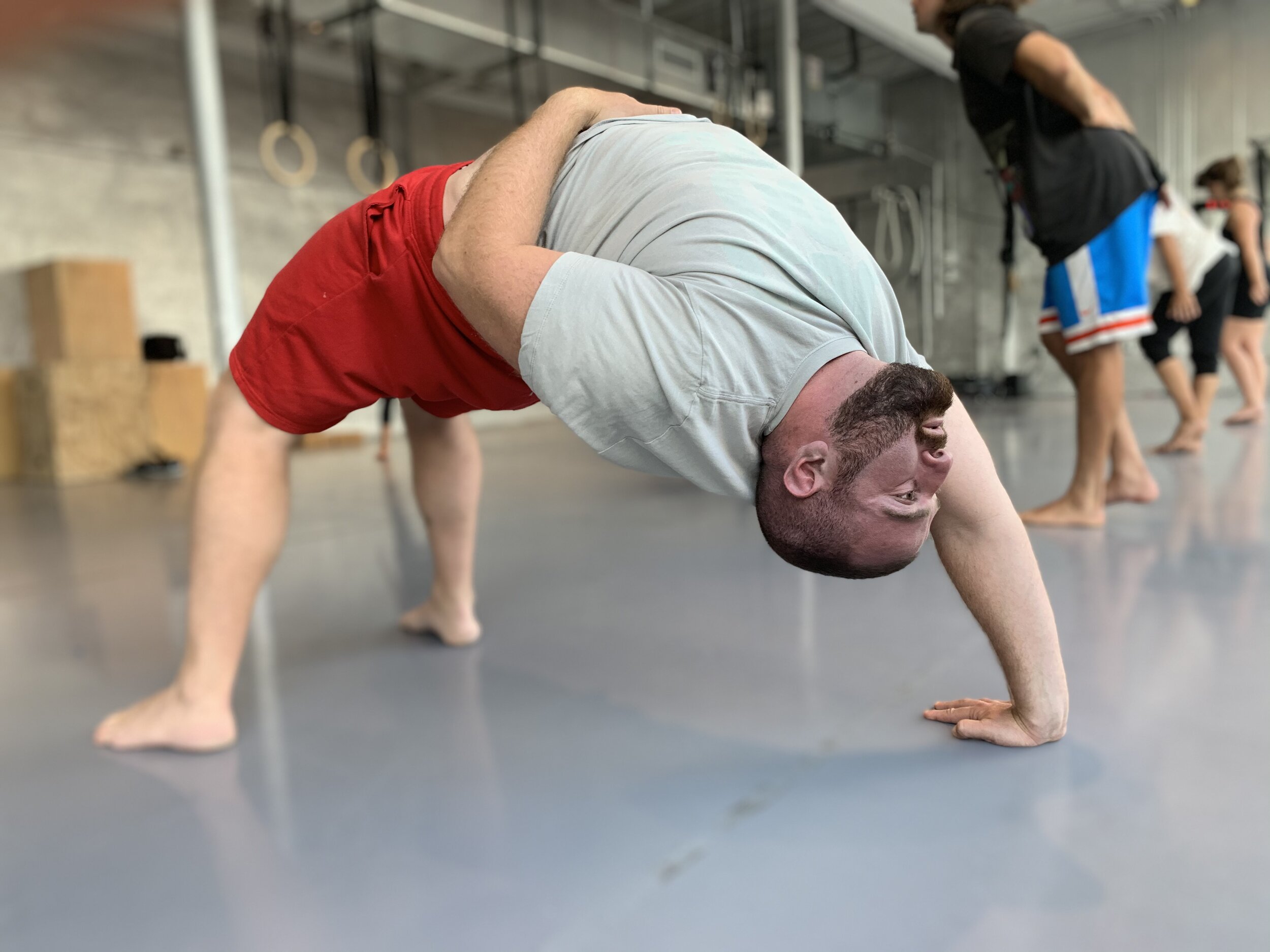
At the beginning stage of Ido’s locomotion system, we are always returning back to a pre-determined transitional point, creating a clear sense of home - a “key” or “mode” that characterizes what can be executed, much like the tonal center of a musical scale / song.
In music, the pitches of notes can be differentiated one from the next, in what is called a horizontal interval. But there is also difference between the pitch of a note and this essential tonal center.
That is to say, it’s not just a question of the relationship of an element to the next one in a sequence, but also the relationship between an element to this transitional point.
By constantly leaving and coming back to this transitional point, carving countless trajectories to and from, we acquire the kinesthetic equivalent of an internalized sense for that tonal center - it becomes a place you can easily leave and come back to, like any musician who becomes proficient with a musical scale.

Movement is a hologram
Movement practice is a hologram - our practice is not in the sum of the parts. It is not defined by the specifics, but more in the path that binds them together.
If you cut a photograph in half, you have two incomplete halves, but if you cut a hologram in half, you still have two complete wholes.
Movement practice is a hologram - our practice is not in the sum of the parts. It is not defined by the specifics, but more in the path that binds them together.
As Gilles Deleuze says - "there is other, without there being several".
This was the punchline on Saturday. We had an intro session for students to clarify the basics of some of the subjects we are tackling lately. We worked on mobility, dynamic posture and reaction games, floorwork, organic and gymnastic strength, proprioceptive mapping, etc…
But what makes this movement, what defines the intrinsic nature of what we do, is NOT those things. It is only contained in them.
If you remove the gymnastic rings, or some system, or a specific protocol, or whatever, guess what - we still have a practice.
Welcome to the hologram.

From zero to one: “fail until you fail to fail”
At first, it feels hopelessly impossible - there’s no way to keep up 3 sticks with 2 hands.
A far cry from adding another rep or kilo; to paraphrase, it’s more like going from zero to one.
How do you start from zero, from 100% failure rate? In the spirit we learned from Ido: “failing until you fail to fail”.
And so we introduce such processes into our practice, to acquire that true beginner’s mind.