

Tendon adaptation - the plot thickens
A recent research study (1) compared long-term changes in the achilles tendon between gymnasts & non-athletes. They found that gymnasts had developed greater muscle-strength, but no differences in tendon stiffness, suggesting “a training-induced imbalanced adaptation of muscle strength and tendon stiffness”. This confirms something Ido suggested almost 10 years ago (2, 3) - gymnasts lack tendon adaptations due to reliance on external springs.
We’ve been doing some bouncing work that specifically affects tendons & connective tissue. By limiting contribution of contractile/muscular elements, we shift the burden to the tendon, taking the energy provided by gravity to store & release it.
As we’ve been discussing in our classes, tendon is a soft-matter tissue. One property of soft matter, and connective tissues especially, is a shift of the stress-strain curve during cyclic loading (strain that loads/unloads repetitively). This shift means that there will be strains at a given load that would not otherwise produce an effect, because there is this repetitive component. Cyclic loading, such as in bouncing, produces the kind of strain that triggers adaptations towards elasticity - changes in proteoglycan content, fibril organization/orientation, and ultimately critical connective tissue properties).
This is a synergetic outcome - you cannot simply add up the effect of disparate jumps. 1+1 = 2 if you’re loading the tissue normally; but 1+1 = 17 when it’s done with bouncing, and a second-order effect arises - tendon adaptation.
1 - The study: Development of Muscle-Tendon Adaptation in Preadolescent Gymnasts and Untrained Peers: A 12-Month Longitudinal Study. https://pubmed.ncbi.nlm.nih.gov/34649260/
2 - RawBrahs interview, the relevant excerpt can be found in “Ido Portal on Paleo Diet, CrossFit, Gymnastics, Motivation, Movement & More” at 4:58 (https://youtu.be/WPnXjFNSf1o?t=238)
3 - Facebook post - November 22, 2018. https://www.facebook.com/portal.ido/photos/a.630345403674110/2342011115840855/
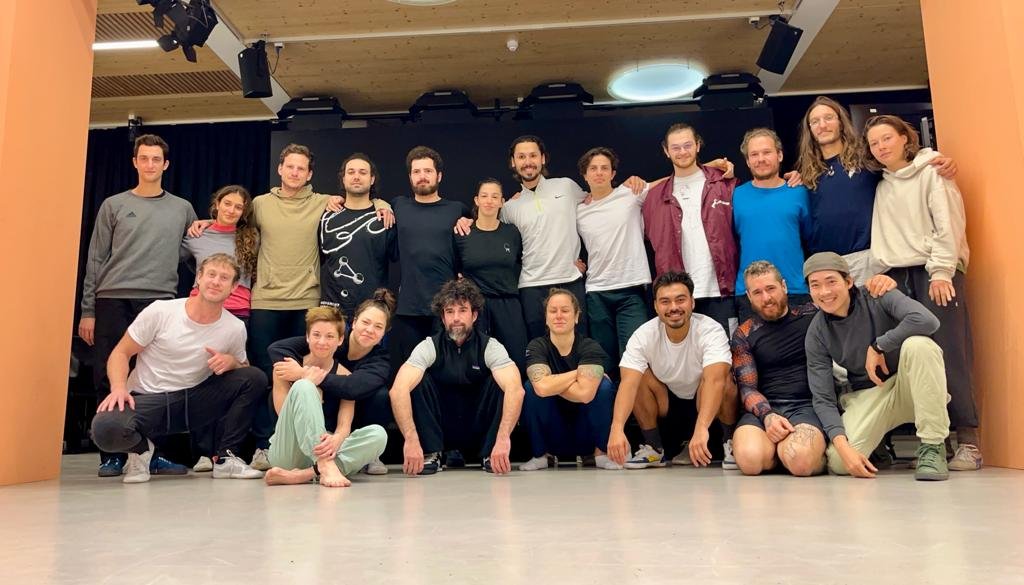
Ido Portal Intensive, November 2021
Just returned from one month with my teacher Ido Portal in Berlin. Through many containers, we examined timeless themes/lessons…
developing will, emotional stability, effortless attention.
going deeper into the life practice, what it means to be a practitioner.
the relational nature of reality, with a current emphasis on the emergent phenomenon that arises from intelligent arrangement of push and pull, active and passive…
And what were the containers used to distribute these lessons? We studied…
boxing and wrestling through multiple entry points, providing a meticulous learning process
acrobatics, where I learned a few new “tricks”, but by far the best gift was a huge upgrade for subsequent development - and it has everything to do with HOW.
methods for separating the active and passive elements of the body, to create clarity and turn the body into the conduit that it can be.
dance through various scores, many instructions, learning to listen to the inner “voice” (arguably the most “you” thing about you, and yet the one we are least familiar with…)
engaging improvisation through the highest mode: listening
various libraries of movement vocabularies/systems that Ido has developed and refined
and the “dark arts”… stillness.
And for the first time, lectures in which Ido shared the knowledge he has synthesized from studies across seemingly disparate fields: physiology, psychology, philosophy, biology, spirituality, etc etc etc.
A major takeaway for all - the practice that centers on the body is uniquely suited among all practices for spiritual/personal growth. If your internal/spiritual practices are divorced from physicality, physical scenarios will crack you to pieces. And because we inhabit a body, even the least physical scenario, like arguing with your spouse, is a physical scenario (just watch your cortisol levels and heart rate rise…).


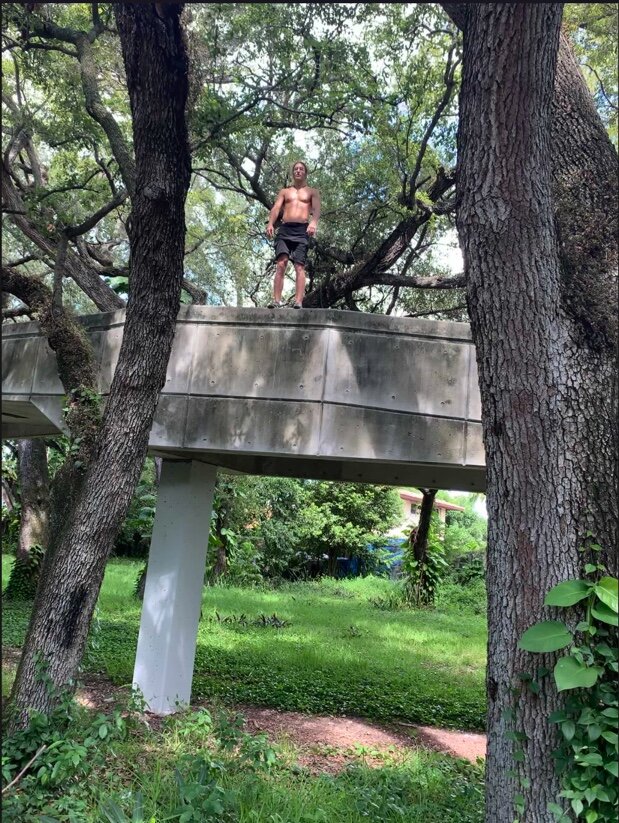
Discussions with a stranger, on my wall to stand on a wall
At the threshold to the path which winds up to my favorite wall, a shirtless man sat in his wheelchair. His belongings, including plastic bags, two bibles, bars of soap, and canned foods were strewn about the floor.
We exchanged friendly greetings; he wished to move beneath the sun and asked for help moving his belongings beside him.
As I began moving bags and books from one spot to another, a conversation sprung to life. It soon became clear that this man was cut from a different cloth as others: his choice of words was deliberate, calculated, and he spoke of sharpening the mind. He probed with ideas, and not one to let an interesting idea drift by, I delayed my training session to speak with this man.
At first, I thought I was benevolently entertaining the incoherent thoughts of a person to whom life has been too harsh, that his fancy words were dead husks around disorganized ideas, a simulacrum of intellectus. But I was soon humbled, and I slowly realized I was face to face with a fully lucid mind. And beyond that, that this was a mind that was very meticulous in how it organized itself, and that I might have something to learn from him.
(It is at this point that I wish to make clear - it doesn't matter how coherent a person is or how fragmented their thoughts are: all humans are worth speaking to. We have something to learn from all. Every soul shines, even if the vessel has been broken by the hardships of this city and society.)
Our back and forth evolved into a discourse. We spoke at length about mind after death, the nature of knowledge and wisdom. He confronted my presuppositions, and when my points were unclear he demanded clarification. In turn, when I requested from him more clarity he was able to provide it as well.
The discussion culminated on some ideas about intuition, which my friend believed was a critical capacity for discerning truth. He called it an aptitude, a capacity for seeing what IS. I added that intuition is the product of observations and experiences (in more or less the fashion of Bayesian inference). In this moment, his eyes lit up as he agreed, and maybe my own reflected it. We paused to dwell in our own independent realizations, the product of a relationship between two minds, that could not have occurred alone.
And on the wall, the fruit…
And as I stood on my wall, letting the events of that exchange percolate through me, a gut punch of realization struck. It was something I always believed, had words for, but now affected me more powefully.
I have long had the idea that we can only know things by refining our models. (Where my friend believes we can know an absolute truth, I am not sure.) And to know anything at depth, it must be juxtaposed against its environment. In addition, it can be used to shed light on the environment. Any phenomenon or philosophy can be a lens for constructing an understanding of the world, but similarly, at this moment of exposure to the world/environment, we gain clarity about that phenomenon as well.
You, like any phenomenon or philosophy, can be used to understand the world, and vice versa.
It reminds me of a description Ido once gave, of rubbing up against the world to know yourself, to discover the contours of your own existence. At this moment, perched on the wall and beneath the trees, this concept became a focal point for pulling together my practice on the wall, my relationship with this man, my interpretation of the ideas we discussed about intuition and wisdom.
And parallel to this, a sense that I am not different from my environment, or from that man. The difference between the inside and the outside, say of a cell, is really only the barrier. But otherwise, there is no difference between those two constructs.
------
What a blessing is a practice that takes you into the world, to rub up against it.
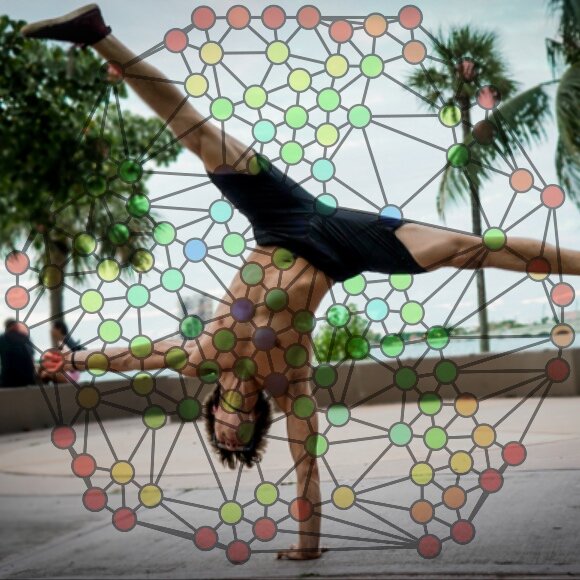
Measuring Importance in Movement
One way to measure the importance of a node in a network/system is “betweenness centrality”.
Betweenness determines importance based on how well a particular "node" serves as a bridge between other nodes - that is, which node provides the shortest path possible between all nodes, with the fewest steps possible.
The node with most “betweenness” provides the FEWEST steps possible, between ALL the nodes.
In the attached graph, it is the BLUE nodes that are the most central, because on average, these nodes represent bridges along the shortest paths for ALL elements, on average. The red nodes represent the opposite.
As an analogy, imagine a city street. It has betweenness if it's most accessible from all other city streets. If a city street is easy to get to from only one place, then it's low in this betweenness centrality (and red, on our graph, and hence pushed towards the periphery). If you count the number of "edges" (connections) from the nodes with various colors, you can see that color generally corresponds with number of connections (but not in a 1:1 fashion).
So take at a one arm handstand: so much time invested, and yet… how many connections does it serve, in the big picture? At best, it yields low to moderate in “betweenness centrality”.
(Of course, betweenness centrality is only one way to measure importance -there is no “general”/absolute way)
Movement as an Open Concept
When I first began to realize that movement, in the sense of the big open concept as Ido describes it, was a direction we could aim for, I began wondering: why don’t we aim then for the yet bigger concept? What would that be – Nietzsche’s uberman, or living like some renaissance being, maybe a spiritual awakening? Am I limiting my potential for growth by “picking” a limited box, compared to the big open concept of “life”?
Flawed reasoning in multiple ways. Here are a few thoughts on why I’ve moved past these concerns.
We can only expand from where we are. If I’m stuck inside box A which is contained in B contained in C, I cannot escape directly to C. So assuming there IS a bigger container than movement, I would still need to pass through movement as container. I can’t even begin to conceptualize what that box might be – I might throw ideas around, but like the virgin imagining sex, I lack references to conceptualize anything accurate.
But maybe there was never a need for such boxes, you say? Why not just escape the containers and breathe the open air of life? Because life as such, when it reflects existence outside of containers, is a disorganized/disorganizing concept – it cannot guide development and growth. Practices provide a gravitational center, an organizing force that allows us to tread a path.
Hence the path to “become” movement – it’s maybe just one rung up the ladder of complexity, but the beautiful thing is that it has contained within itself the means to climb down or laterally and scope the territory and see other rungs, to deconstruct and reconstruct and deterritorialize and reterritorialize. It instills the essence and installs the tools for navigating complexity, and being a praxis, it prevents you from getting “lost in the sauce”. There’s nothing lost by dedicating a life to this concept and practice.