
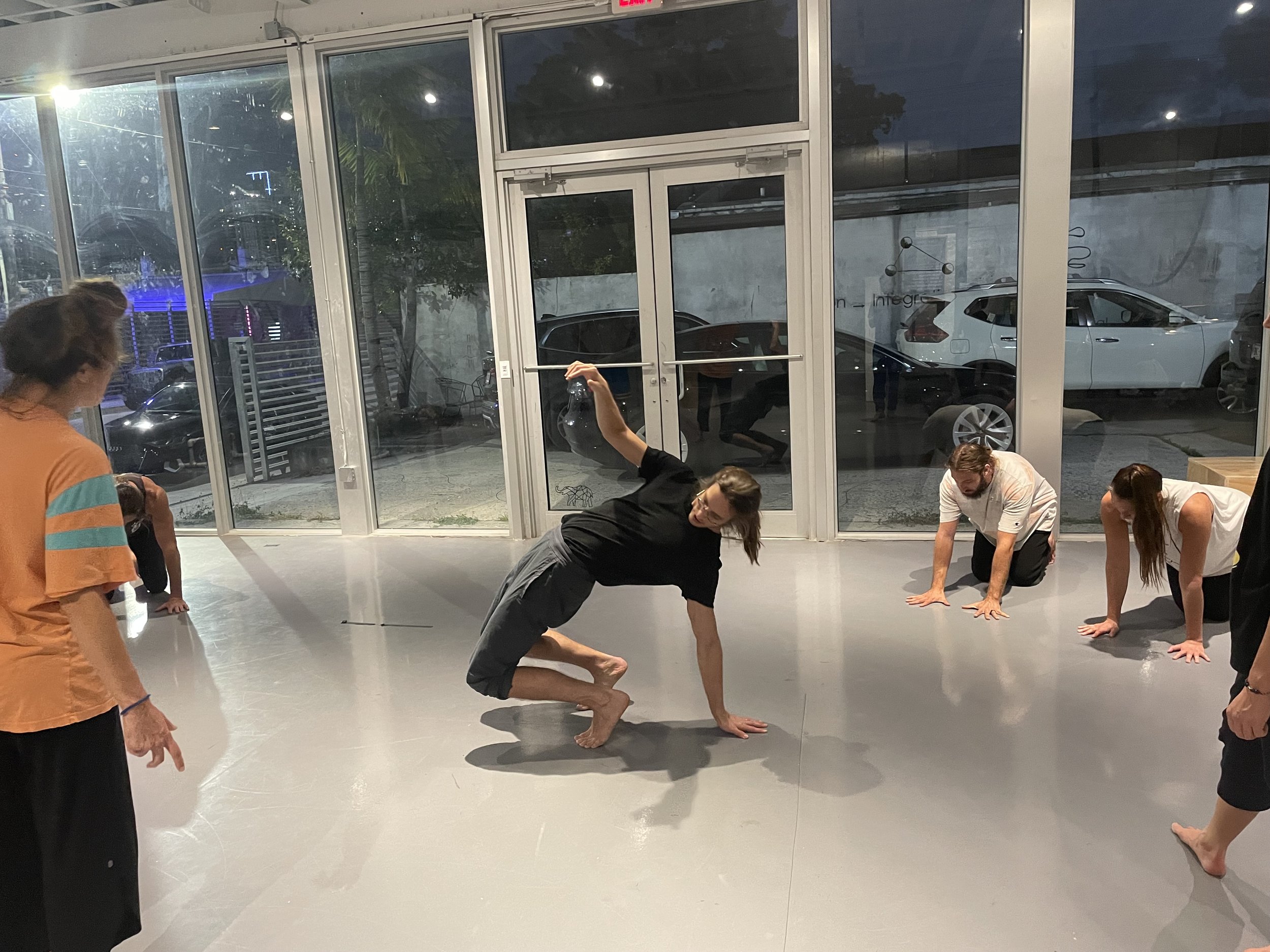
Movement is a Life Practice: Using Obstacles
So much in our lives pulls us away from practice.
So it’s important to keep revisiting how practice is changing us, appreciating how it makes us more connected with our body and emotions and intellect. I remind myself often how this starts to affect how I connect with other people, even affecting my ability to be a father.
Somewhere along the way, this practice moves from an idiosyncratic hobby to a true life practice.
For example, when the “formal” practice is blocked. A screaming baby, a broken AC unit in the gym, being stuck in traffic…
A lot of sessions will be missed. But should I go and make it worse by getting angry? Now I lost the session, but I also lost the opportunity to practice my patience! Two losses!
The frustration itself becomes grist for the mill, an opportunity to practice our patience.
And what is this, lip service to patience? Managing frustration and cultivating patience is a HUGE part of practice, especially when you’re engaged in a practice that fundamentally addresses your weaknesses.
Yes, dealing with weaknesses is frustrating at times. But the practice of patience allows you to see it, without identifying with it. This becomes a critical skill for when you are in the session.
If this practice is to be something really valuable, really transformational, then it can’t be only about the specific tasks, improving our strength, etc. It has to give us tools and opportunities to become more.

“We can only make things worse”
Any act of creation should involve a recognition - there is already an essence/nature pre-existing your intention. Your work is to take this essence which exists in some form, and cultivate it towards some direction. The true skill of the craftsman is in setting the intention, and not letting the intention destroy the process.
Someone who prepares coffee described this in the context of his craft: he can only make the coffee worse.
It’s not just him - every step of the way from cultivation of bean to preparation of cup, where an act of “creation”, of reforming the energy… the essence can only be degraded. Not improved upon. In fact, even HOW the coffee is drank, mindlessly or with intention, will destroy or sustain this essence. What you do with the energy the coffee gives you, etc…
So the craftsman can only worsen the creation. But without the craftsman, there is no creation at all. His presence/intention introduces an active force, which necessitates the response from the universe - resistance comes into being.
This gives a succinct definition of quality - creating without destroying the essence.
And this applies to the role of the teacher: recognizing that you cannot take people to an end-point, but only facilitate their own unfolding. A teacher can never improve another - they can only help clear certain things so the “natural” essence of the individual can blossom.
And these two, the intentional creation and the essence… they are best served by appreciating the other. Creation is always better executed in the context of understanding the essence of the energy; and the nature of a thing to grow will always be able to move further, will be given more room, when something external to it helps it.
And why is that? Because only something external to the object is knowledgeable of the outside conditions, in a way the object can never be. It can never be subject to itself. Hence, relationship becomes pivotal.
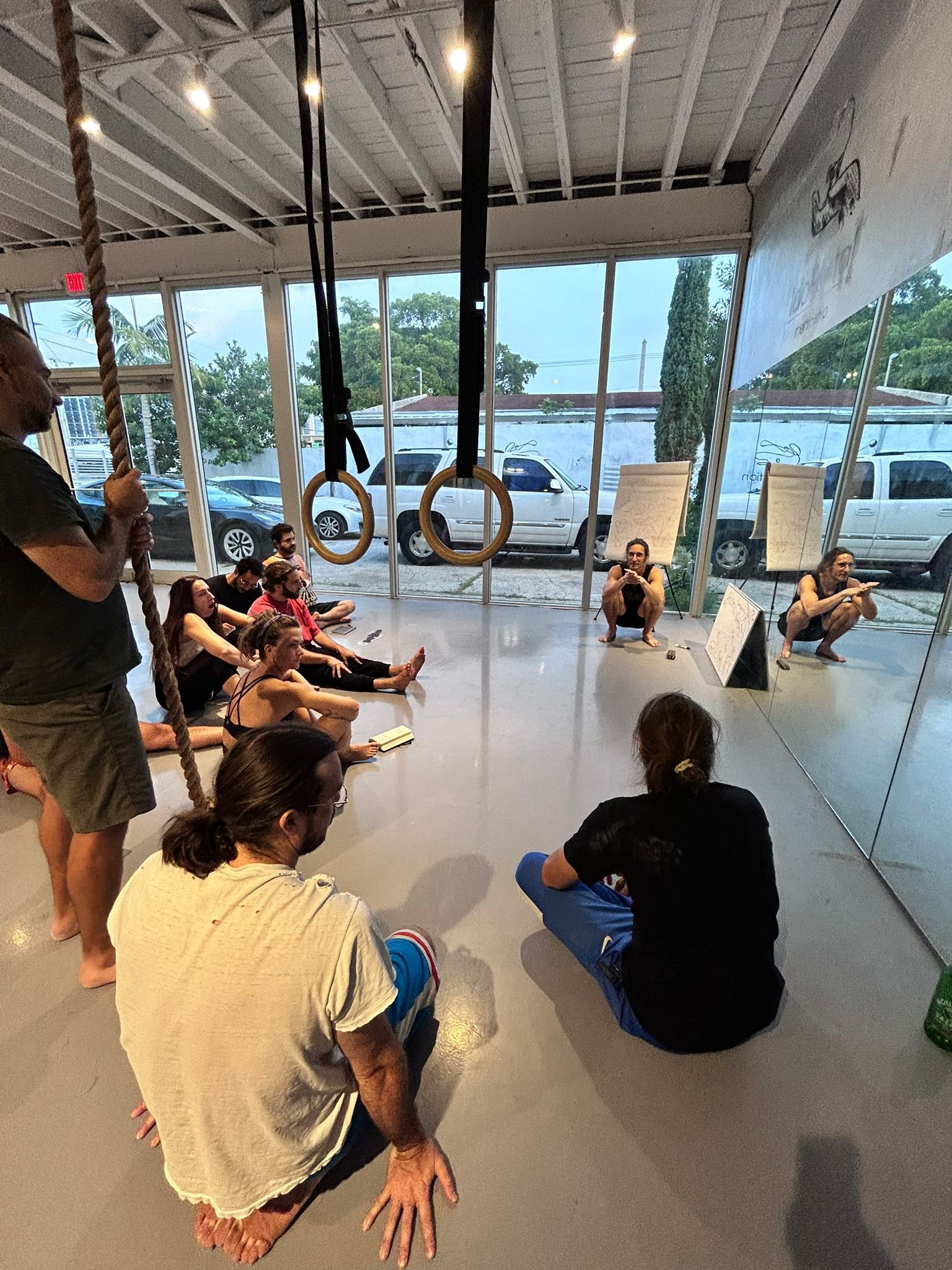
Mapping a Practice

We will often map out our practice, diagraming where we’re at, what we’re focusing on, our objectives, etc.
A map might lend the illusion that the practice is neatly categorized into cute little boxes. But the intention behind such a map is not to promulgate the illusion of hierarchical order. It’s to provide a pragmatic starting point for a more dynamically alive conceptualization based on engagement.
The map will have to be redrawn anew, over and again, forevermore, because the territory will change as a reflection of our own evolution. That’s inherent to *practice*, where WE are part of the territory.
Complete systems are already impossible in purely objective systems - this is nothing compared to practice in which subject and object are both interwoven!

Ido Portal Berlin Intensive 2023
Dear diary, I’m back from my trip to Berlin to visit my teacher Ido Portal. Here is how it went
Schedule
Every day started at 7:30AM with a one hour meditation. One day, he took it into almost two hours. This is a deep practice, and the offering was made - sustain it for one year, every day.
Then a quick breakfast, and the first session began.
Structure and Organization of the Body

The morning sessions were led by Ido, and touched on a few subjects. Usually we would start with a focus on structure and organization of the body. After doing this kind of work, your body transform in profound ways. This is unlike the sense of acquiring a skill, or improving an attribute. Instead, a more general capacity improves - the way the body organizes itself in relation to all tasks.
It’s a massive development for the field of movement, and I’m eager to see the downstream effects on the movement culture, as has happened with so many of Ido’s other insights. As he has done countless times before, Ido has breathed fresh thought into something we take for granted - in this case, the way we see something as broad and encompassing as structure and organization of the body.
Boxing as Movement Practice
Most days we worked also with boxing. This process was presented, not to become fighters, but to use fighting to get what it is uniquely suited for - for example, to work on emotional modulation and to cultivate presence and adaptability inside a chaotic scenario. (It has been my experience with this work that it’s some of the most important for me personally - for what it offers to awareness of emotions and working with distracting thoughts.)
This was a very LIVE practice, built from Ido’s own research and development in this field. It is telling how Ido can take a mixed group, including many who never put on gloves before, and take them through two weeks with nary an injury.
Learning to learn
We worked also on tasks for improving how a person learns, for example developing the ability to “chew” on complex patterns. Not in a cerebral analytic way, but solving the puzzle WHILE the puzzle is changing. Only one solution exists - to bring presence. You don’t get to take such riddles home to solve them; the riddle gets solved, here and now, or not at all.
Many other things were tackled, addressing strength, focus, touching the floor, etc…
We would take lunch for a short break, then back for the PM session.
A different route towards improvisation
Odelia would lead the second session. This session built up over 2 weeks in the direction of a very open and free improvisation, but it got there by way of a gradual process.

It began with creating a sense of differentiation in very simple movement patterns. This was reminiscent of Ido’s “transcription” model of learning skills - whereby we do not learn things from scratch, but always use prior learnings to form them. If our prior learnings are unrefined, so too will be the outcome of learning the new skill.
So Odelia gave us very simple patterns to start, but the next step was the critical piece - she added elements to ensure we not just perform reps of a warm up exercise, but that we invested ourselves into examining relationships in the body in the context of these patterns, sensing them, and through this BECOMING them.
With these basic pieces of genetic materials built up, we were able to create or revisit a vocabulary of groundwork in a completely different way. The approach is antithetical to the common approach to teaching skills, the “monkey see monkey say monkey do” approach.
The subtext: the concepts we worked with

Every day finished with a lecture from Ido, usually spanning about 2-3 hours. These touched on topics ranging from the origins of movement development and motor control systems, to working with negative emotions and distracting thoughts, to the power of parables and secrets for transmitting truths, and wrestling with models of the nature of reality to cultivate better work.
Throughout these 2 weeks, there was a major emphasis on observation of emotions, as well as noticing thoughts. Not in a wishy washy way, but in a direct concrete way. And this is something Ido brings to the space of inner work, that is often missing - application platforms, wet-tests, an actual DOING.
It makes me think of how a spiritual teacher from the past had his students perform hard manual labor as practice. If you look nowadays, you don’t see the current mantle-bearers of this teacher’s work doing the same. The work has become all talk, theory, esoteric knowledge. Ido is making sure that the DOING remains in place.
Concluding thoughts
As usual, Ido’s process is very innovative; not creativity for creativity’s sake, but engaging in honest problem-solving to solve the issues and limitations that come up in learning, or posture, or focus, or boxing, or dance, or acrobatics. It is, as in usual form, completely non-dogmatic, practical, and yet contained within a greater perspective. Hence, this is a process for those who truly wish to grow.
And in the end, though all this priceless knowledge was presented, nothing was “given”. Because nothing worth having can be given. They need to be taken, manufactured for yourself. Ido’s gift was his presence, his embodiment being capable of “taking” and presence.


You are a locomotive pendulum
What’s unique about these patterns - they have a cyclical nature. And a pattern that is cyclical allows for a recycling of energy in the body.
This is such an intrinsic part of mammalian physiology that the nervous system has dedicated networks BELOW the spinal cord for locomotive patterns. These central pattern generators don’t involve the primary motor cortex. They are reflex arcs; they bypass the brain entirely.
This means… you don’t walk the way you learn to write. It can be seen on infants - you don’t need to push their legs forward; put the weight on one leg, and the opposite leg immediately swings forward in the natural gait mechanic.
Interestingly, CPGs are clearly evident in animals, less so in humans. The fact that CPGs are a bit harder to detect in humans hints that our modern choices deprive us of this basic capacity, that we are losing an innate efficiency in how our bodies operate.
Ido Portal introduced a while ago the idea of locomotive patterns as a practice. They are still potent over a decade later.