

Working With Emotions
Practices have much to offer, but only if you know to look. For example, the rail can teach about emotion.
Emotions are felt, not thought. All this idea of talking about emotions, misses the point about learning to actually feel them. You can spend years talking about emotions, and never get anywhere in terms of developing your relationship to them.
Movement practice gives a pragmatic means of working with emotions.
For example, the rail introduces a specific emotion: the fear of falling. It’s palpable. You can pave over this sensation with reps, or you can observe it, and when you do, you start to understand its nuances.
The vector of development isn’t to stop experiencing emotion - it’s to sense the subtleties within it, to notice how they affect your totality, to be able to accept these emotions without disengaging, and ultimately to use them as they are meant to be used: carriers of meaning.
This doesn’t stay within the practice session. When you go about your day, you will recognize emotions hiding in plain sight, the richness of the emotional landscape unlocked.

work on all 3 layers
You exist in three layers: your human layer, your movement layer, and your performance layer. What Ido called Homo Sapien/Homo Motus/Homo Specialitas. A practice can serve any or all 3 of these.
Your human layer: you as a villager, you without any specific interests but life. Yet you live, age, and die in a body. And your practice can care for that body - keeping joints healthy, staying nimble.
Your movement layer: how you move. The pursuit of movement quality, creating new connections and relationships in your body, exploring what possibilities embodiment affords.
Your performance layer: any domain of movement can become a “field”. Some become their own pursuits - acrobatics, athletics, dance, martial arts.
Most practices focus on one of these - staying healthy, working on better movement quality, or acquiring technical proficiency. But it’s possible to work on all of them.
(There is a fourth layer, or perhaps more of a core, that can also be addressed or neglected by a practice…)

Reflections on Ido Portal Weekend Event
HOW you move
A connected body is one in which all the parts conspire together towards an outcome. And this was offered, not as an idea, but through DOING. We did it fast, we did it slow; we did it vertically, we did it horizontally; we did it in calm, and in chaos; we did it with ease, and we did it with effort.
What emerges is a connection that doesn’t depend on circumstances, but on awareness.
Amortization, In-betweens
Between the eccentric and concentric phase of a movement, there is a transition moment which can be used, if the body is educated. Between stillness and movement, there is also a transition. Time was spent in these in between spaces, learning to cultivate intention, organization, equalization.
The offering
So many weekends flash past us, days evaporating before our eyes. An alternative was offered here: to show how much consciousness and presence can be brought into a single movement. Developing not just critical movement capacities, but installing them with a quality of attention and intention.
Practice
The offering here is clear: the idea of PRACTICE. You weren’t just fed a technique, nobody gave you psychedelic tea. You had to bring yourself to the table.
It wasn’t about a single weekend or experience. What was shared was perspective and tools to continue to pursue such depth and meaning in our lives, whether in the next movement session, family dinner, getting stuck in traffic, argument, moment of panic, loss, gain…
Going inwards = connecting to others
Curiously, we spent 2 days going INWARDS, and yet afterwards, the group seemed more connected, there was more openness between people. How can it be? Perhaps because if you go deep inwards enough, you find what’s common across all people.
Pursuing complexity by beginning with simple conditions
“A complex system that works is invariably found to have evolved from a simple system that works.”
And this is how we worked: we didn’t invest in long elaborate sequences, complicated buildups of techniques, etc. We were given the recipe for a fertile soil of connection in the body, and then seeds in the form of various challenges were planted - what emerged was a naturally emergent complexity, one that belongs intrinsically to the participant.
Philosophy of movement practice: because context matters
Movement vs movements, practice vs practices. Creativity. Subjectivity. And more…
We WORKED
But it wasn’t about talking. The philosophy served the doing. And we did. We WORKED. People reported depths of soreness over the subsequent days, in places they had never been before.
Why practice torso movement?
Why practice torso movement? We can appreciate what we take from it, looking at the body (hardware), what we can do (apps), and how we move (the operating system).
A) Hardware: what is the primary physical adaptation? Mobility in the torso, especially in smaller segments. Don’t forget that all of the big ranges of motion are built up from smaller segments. Addressing a small segment means improving the many larger ranges that include that segment (vice versa doesnt work the same way)z
B) Applications: what movements become possible after such work? First, it allows you to work with improvisation by building up elaborate systems.
It also delivers very important sub-processes : the small separation allows you to recruit more segments in kinetic chains, contributing to better force transmission.
C) Operating system: what effect does it have on how we move? It develops movement quality. For example, the ability to smoothen movements, to dynamically adjust the level of tension necessary to achieve an outcome while maintaining details and standards.

If the handstand was a computer…
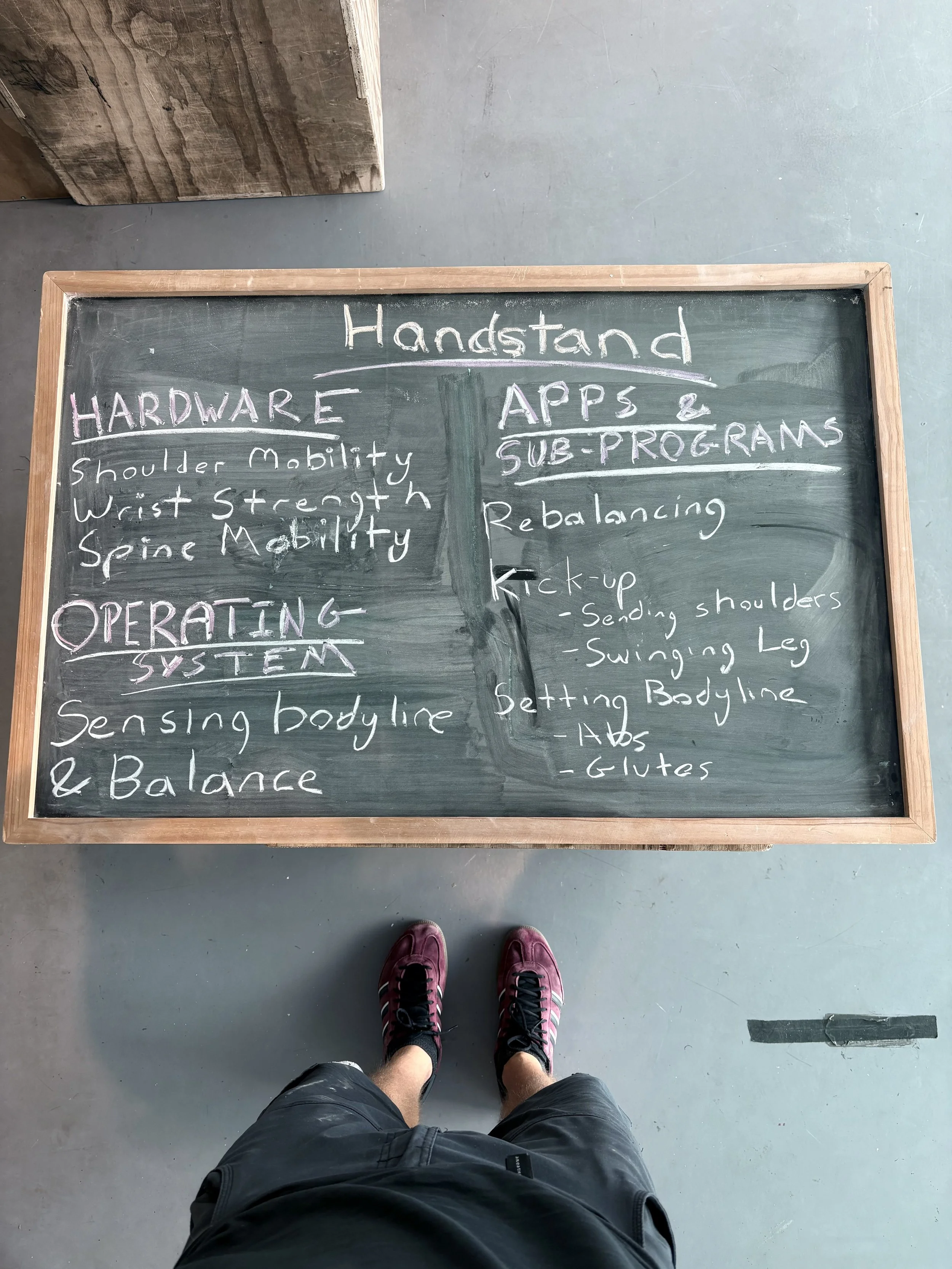
If the handstand was a computer, what would it look like?
This was the model we used to approach the handstand in classes this week.
To perform a handstand requires a certain “operating system”: The internal representation of a body-line (the straight line from the head to the feet), the ability to sense balance (the shifting of the center of mass), etc. The same technical drill can deliver these, or not, depending on where the attention is.
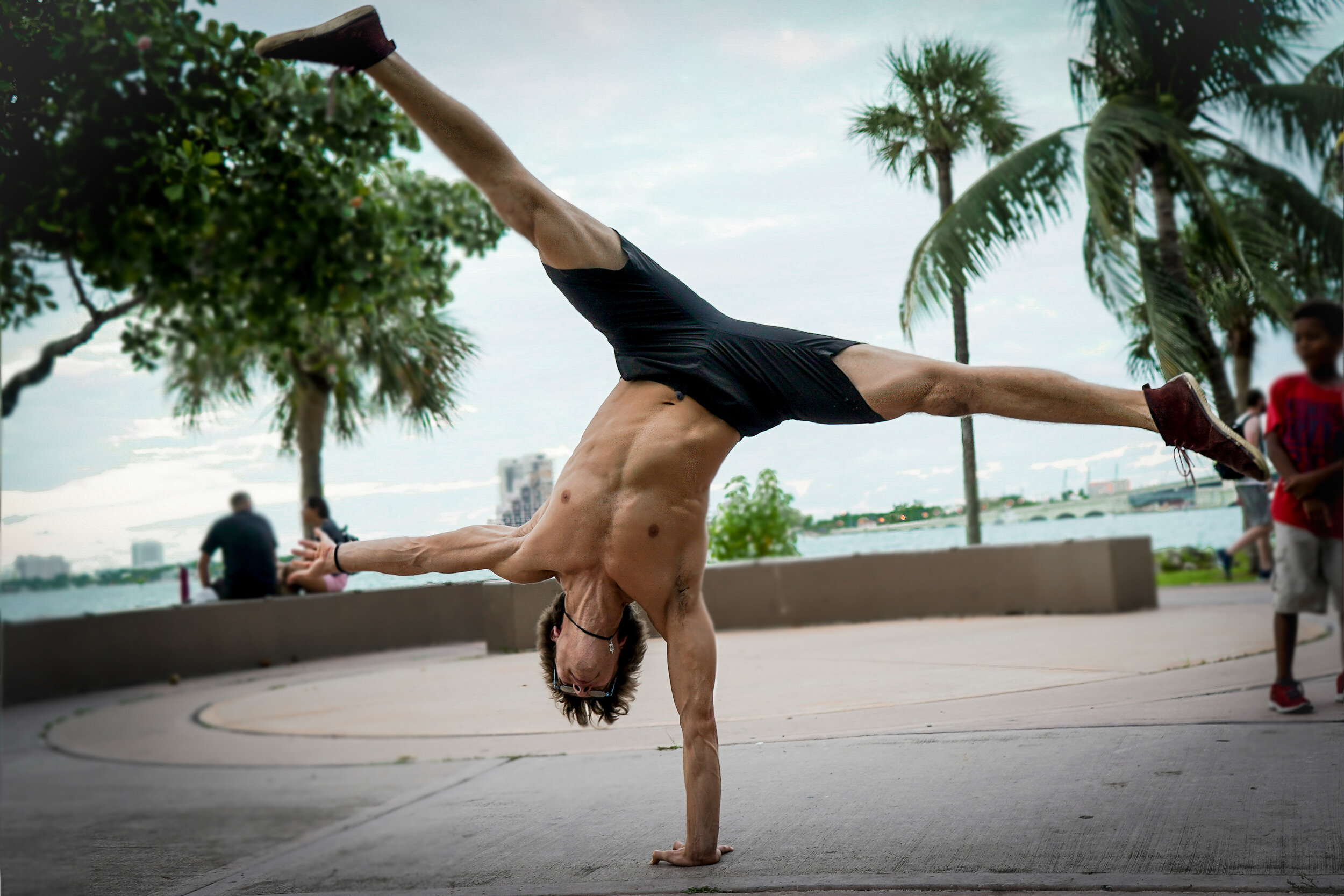
You could look at the one arm handstand and think it’s a huge development over the two arm handstand. In truth the operating system required is very similar. You need only slight improvements in the pre-existing O.S. to achieve it - a small upgrade.
Dynamic freedom on the hands, however, requires a substantial system upgrade. It has dependencies on spatial management, peripersonal space, sensing gradations of tension, etc.
If you’re learning the handstand for YOUR development, you want to focus on the operating system.
All models are wrong, but for now, this one is useful. This model has an expiration date for us. We can use it for some period of time, beyond which it starts to serve itself, and not our own development.